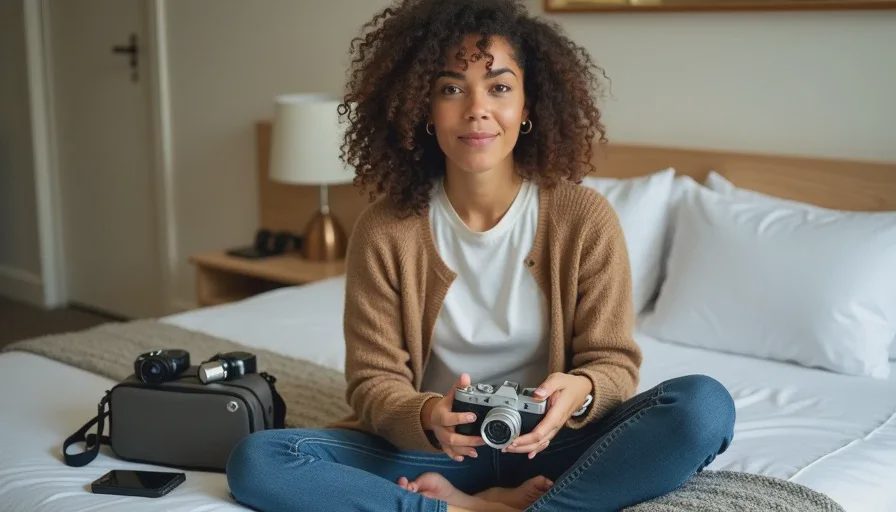
I used to overpack for trips. Not clothes — camera gear. I'd bring a big DSLR, two lenses, a flash, a tripod, and a bag of accessories that never left the hotel room. Half the time I just used my phone. The rest of the time I was too tired from carrying everything to actually shoot.
Now I travel with a carry-on camera kit that fits in a small pouch. It's not the fanciest setup, but it's the one I actually use. When I'm on the road shooting beauty looks — a makeup look in Seoul, a street-style portrait in Mexico City, a quiet detail shot in a Marrakech courtyard — this is what comes with me. Here's what's in the bag, and why each item earns its place.
The Golden Rule: If I Won't Carry It, I Don't Bring It
Every photographer I know has a drawer full of gear they thought they needed. Mine is no different. The difference now is that I test my kit before every trip. If I don't use a piece of gear in the first two days, it probably didn't need to come. And if it's too heavy to carry for an entire afternoon, it's not coming either.
The best camera is the one you have with you. But the second-best camera is the one you actually want to pull out of your bag. A heavy DSLR that stays in the hotel room is useless. A small camera that fits in a crossbody bag gets used. That's the whole philosophy.
What I Shoot, and What That Requires
Most of my travel photography falls into three categories: portraits of people I meet, detail shots of makeup and products, and environmental shots that show a place. None of those require a giant lens. They require decent light, a lens that can get close, and a body I can hold steady. That's it.
The Core Kit: Three Cameras, One Pouch
I carry three cameras, and that sounds like a lot — but two of them are already in my pocket and my hand.
My Phone
This is the workhorse. I use it for 70 to 80 percent of my travel photos. The camera on a modern phone is good enough for most portraits and detail shots, especially in good light. I shoot in the stock camera app, lock exposure and focus manually, and slightly underexpose to protect highlights. If I need a wider shot, I step back. If I need a closer shot, I move in. No accessories, no lens attachments.
The phone also does something no other camera does: it's always there. When a good moment happens, I don't have time to unzip a camera bag. The phone is already in my hand.
A Compact Film Camera
This is my second camera. It's small, lightweight, and loaded with a roll of 35mm film. I don't shoot everything on film — film is expensive and developing takes time — but I use it for shots where I want that soft, slightly imperfect film look. Portraits of people I meet, quiet street scenes, a detail of a lipstick tube on a café table.
Film forces me to slow down. I take one shot instead of twenty. I think about the light before I press the shutter. That discipline carries over to my digital work, too.
A Compact Digital Camera
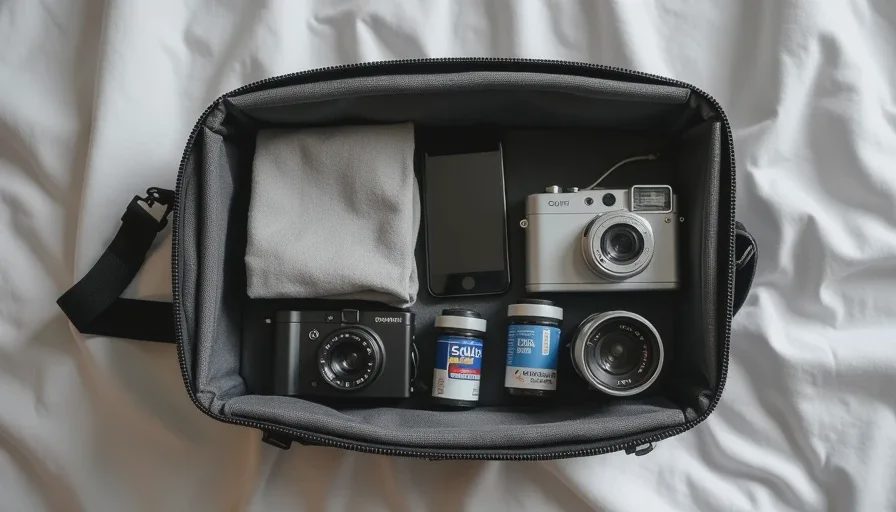
This is the newest addition to my kit. It's a small point-and-shoot with a fixed lens and a sensor that handles low light better than my phone. I use it for situations where I need more control than my phone gives but don't want to carry a full DSLR. It fits in the same pouch as the film camera, and the battery lasts for days.
The fixed lens means I can't zoom. That's fine. I've learned to move my feet instead. And the photos have a quality that my phone can't quite replicate — a certain depth and softness that works beautifully for portraits.
The Accessories That Earn Their Space
Accessories are where overpacking happens. I've narrowed mine down to five small items. Each one earns its space because it solves a specific problem.
A Small Lens Cloth
This sounds minor, but it's the item I use most. Phones and lenses get smudged from sunscreen, makeup, and fingers. A clean lens is the difference between a soft, hazy photo and a sharp one. I keep a lens cloth in every bag.
Two Extra Rolls of Film
If I bring the film camera, I bring extra film. Two rolls is usually enough for a short trip. For a longer one, I buy film on the road if I can find it. Film is small and light, so it's never the thing that weighs me down.
A Small Battery Pack
My phone is my primary camera, which means it dies faster. A small battery pack keeps it alive through a full day of shooting. I keep it in my day bag, not my camera pouch, but it's part of the kit.
A Tiny Beanbag Tripod
This is the one unusual item in my kit. It's a small fabric pouch filled with beads or rice, and it lets me rest my phone or compact camera on a table, a wall, or the ground for steady shots. It weighs almost nothing and solves the low-light problem without a full tripod. I use it for self-portraits, detail shots, and long exposures of city lights.
A Simple Wrist Strap
This is for the film camera and the compact camera. A wrist strap costs a few dollars and prevents the kind of drop that ends a trip early. It also makes the camera faster to grab.
How I Pack It
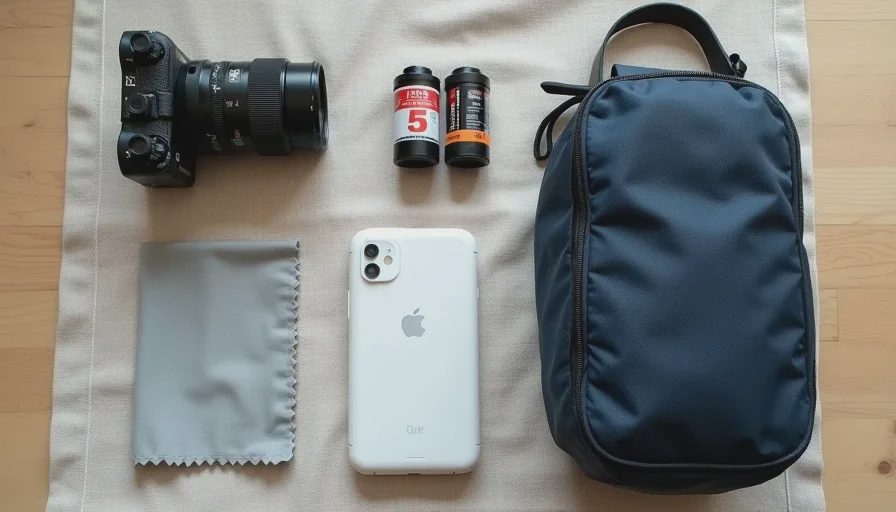
Everything fits in a padded pouch that's about the size of a paperback book. The film camera, the compact digital camera, the extra film, the lens cloth, and the wrist straps go inside. The battery pack goes in my day bag. The beanbag tripod flattens into the bottom of the pouch.
The whole thing weighs less than a bottle of water. I can carry it all day without thinking about it. That's the test. If I forget I'm carrying it, it's the right kit.
What I Leave at Home
Here's what I no longer pack, and why.
The Full DSLR
I sold mine two years ago. It was a great camera, but it was too heavy for the way I travel. I missed shots because I didn't want to carry it. That's the opposite of what a camera should do. If I need that kind of image quality, I rent or borrow for a specific shoot. For everyday travel, my phone and compact camera are enough.
Multiple Lenses
A zoom lens for a compact camera is a compromise I'm not willing to make anymore. The fixed lens forces me to compose more carefully, and the image quality is better. When I shot with a DSLR, I carried a prime lens and a zoom, and I almost always used the prime. Now I just have the prime, permanently attached.
The Tripod
I used to bring a full tripod everywhere. It was heavy, it was awkward, and I used it maybe once per trip. The beanbag does most of what I need, and I can lean my phone against a water bottle in a pinch. Full tripod stays home.
The Real Lesson
You don't need a lot of gear to shoot beauty on the road. You need a camera you actually want to use, a way to steady it, and clean glass. That's most of it. The rest is just light and attention.
Every time I pack my carry-on camera kit, I remind myself that the goal isn't to come home with a hundred perfect photos. It's to come home with a few true ones — the kind that actually look like the place I was standing in, and the person I was with. That's what I'm after. And it all fits in a pouch smaller than a paperback.
So if you're planning a trip and wondering what camera to bring, start with the one in your pocket. Then add one small camera you love, a lens cloth, and a way to steady your shots. That's a kit. The rest is optional.

No notes yet — write the first one.