If you have ever finished your makeup, opened your phone camera, and wondered where the lovely face in the mirror went, you are not doing anything wrong. Learning how to take good makeup selfies is mostly about light, camera placement, and a few small makeup adjustments. Your phone is not an impartial observer; it flattens dimension, exaggerates texture, and often chooses the least flattering exposure. Let me show you how to work with it instead of fighting your own face.
Start with light, not makeup
The easiest upgrade is moving toward a large window. Face the window directly or turn slightly so the light falls across both eyes. Avoid standing with the window behind you, because your face will become a shadow. Direct midday sun can create hard lines under your nose and brows, so a sheer curtain is your friend. On cloudy Seattle mornings, I often get the softest, most forgiving light without doing anything except stepping near the glass.
Bathroom lighting is usually a troublemaker. One overhead bulb throws shadows beneath the eyes and can make carefully blended foundation look uneven. If your only option is a bathroom, turn on every light, stand as far from the mirror as the room allows, and add a small lamp in front of you if it is safe. A tabletop LED mirror with adjustable brightness can help, but you do not need an expensive setup. A $15 clip-on phone light is enough to test the idea.
Before taking how to take good makeup selfies advice from a filter-heavy tutorial, look at your actual light. Take one photo beside a window and one under the ceiling fixture. The difference will teach you more than another new concealer.
Prepare makeup for a camera
Phone cameras can make makeup appear lighter and less dimensional than it looks in person. That does not mean you need a full editorial face. It means you should check balance from a short distance. Sheer foundation or skin tint usually photographs naturally, while a thick layer can emphasize dry patches. Apply a small amount around the center of the face, then blend outward with fingers, a damp sponge, or a brush.
Cream blush is especially helpful because it keeps cheeks from looking flat. Place it slightly higher than the fullest part of the cheek, then soften the edge toward the temple. Add a little powder only where shine distracts you, such as around the nose or center of the forehead. A completely powdered face can lose its liveliness on camera.
Brows deserve a light hand. Fill only sparse areas and brush through the product so the front stays soft. For eyes, a curled lash and one coat of mascara often read better than several thick coats. If you wear eyeliner, keep the line close to the lashes and check that it is visible when your eyes are relaxed. The goal is not to disguise yourself. It is to give the camera enough contrast to record the look you created.
Find your camera angle
Hold the phone slightly above eye level, not dramatically overhead. A small lift opens the eyes and keeps the jawline from looking compressed. Tilt your chin forward a fraction and then down; this stretches the neck naturally without creating a stiff pose. Turn your face about 10 to 20 degrees instead of facing the lens perfectly straight on. Try both directions, because your preferred side is often a lighting preference rather than a permanent rule.
For how to take good makeup selfies, distance matters as much as angle. Close-up wide-angle photos can enlarge whatever is nearest the lens, including the nose or forehead. Step back and use a modest zoom, such as 1.5x or 2x, if your phone still produces a sharp image. Use the rear camera with a timer when you want the most natural perspective. It is less convenient, but the lens is often better.
Clean the camera lens before you start. A fingerprint creates haze and lowers contrast, making skin look dull. Set a three- or ten-second timer, relax your shoulders, and take several frames while breathing normally. The best photo is rarely the first one.
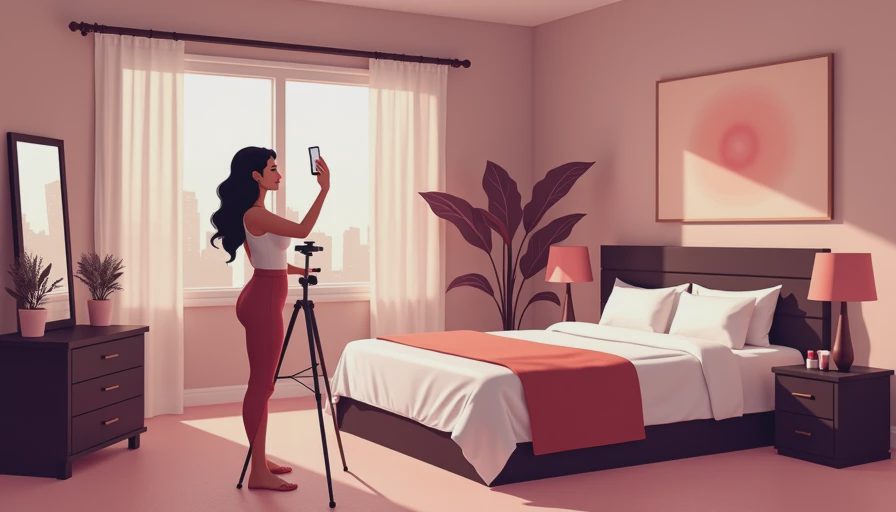
Use expression, hair, and clothing together
A face, a hairstyle, and an outfit are one thing, not three. If your makeup is soft and glowy, loose hair or a simple tucked-back style may support it better than a complicated updo. If you are wearing a bold red lip, a plain top can keep the photo from feeling visually crowded. Vintage earrings, a scarf, or a textured sweater can add interest without competing with your eyes.
Practice a relaxed expression before pressing the shutter. Let your lips part slightly, exhale, and think of something that makes you feel warm rather than forcing a smile. For a smiling photo, press your tongue gently behind your upper teeth; it can help the smile feel less tense. Take a few photos looking directly at the lens, then glance just beside it. That tiny change can make the result feel candid.
When learning how to take good makeup selfies, do not judge a photo only by whether every feature looks symmetrical. A good selfie captures mood, color, and the way you felt in the look. You were already beautiful before the shutter clicked.
Choose camera settings that show real skin
Turn off beauty filters while you are learning. Smoothing can blur blush, liner, and skin texture, leaving you unable to tell whether your makeup actually works. You can lower exposure slightly if the image looks washed out, but do not darken the whole photo until your complexion looks gray. Tap your face on the screen to set focus and exposure, then slide the brightness control up or down in small steps.
HDR can help with a bright window, though it may soften the dramatic contrast of an evening look. Portrait mode is useful for a simple background, but hair edges and earrings can confuse the blur. Take one standard photo as a backup. If you edit, begin with cropping and a modest brightness or warmth adjustment. Skip changes that alter your facial structure or skin color; the most convincing result still looks like you.
A five-minute selfie routine
Start by wiping the lens and finding the brightest soft light. Place your phone at eye level or slightly higher, then step back far enough to avoid a distorted close-up. Check your hairline, lipstick edges, and any visible powder before setting the timer. Take three straight-on images, three with your face turned slightly, and three with a relaxed smile or a neutral expression.
Review the photos at full size rather than relying on tiny thumbnails. Look for open eyes, even lighting, and a calm expression before worrying about microscopic details. If your makeup disappears, add a touch more blush or lip color and try again. If the result looks heavy, remove product instead of increasing the camera filter. This simple process is how to take good makeup selfies without buying a new palette every time a picture disappoints you.
The most flattering selfie is not the most edited one. It is the image where the light, makeup, hair, clothing, and expression tell the same story. Give yourself ten unhurried minutes, experiment with your own phone, and keep the photo that feels like you. You're already beautiful.


No notes yet — write the first one.